Wound Care vs. Scar Care: What to Use at Each Healing Stage
Wound products support the open healing phase; scar products belong to the closed-skin phase. A stage-by-stage guide to using the right one at the right time.
Wound care and scar care are connected, but they are not interchangeable. A fresh cut, graze or burn needs protection and an environment that supports closure. A scar product is intended for skin that has already closed. Using the right category at the right stage helps avoid irritation, contamination and delayed healing.
This guide covers minor wounds suitable for home care. Deep, gaping, heavily contaminated or infected wounds; animal or human bites; significant burns; wounds with embedded objects; and wounds in people with diabetes, poor circulation or immune suppression need professional advice.
Stage 1: stop bleeding and assess the injury
For a minor cut, wash your hands and apply gentle pressure with clean material until bleeding stops. Rinse the wound with clean running water and carefully remove visible surface dirt. Clean around it with mild soap, but avoid repeatedly pouring harsh antiseptics into the tissue unless a clinician directs you.
Seek urgent care if bleeding will not stop, the wound is deep or gaping, sensation or movement is affected, or the injury may need closure. Check whether tetanus vaccination is up to date according to local guidance. For burns, cool the area with cool or lukewarm running water; do not apply ice, butter or household remedies. Large, deep, electrical, chemical or facial burns require medical assessment.
Stage 2: protect the open wound
Once cleaned, a minor wound generally benefits from being kept protected rather than allowed to dry and crack. The American Academy of Dermatology recommends a moist, covered environment for many small injuries because it can support healing and reduce scab formation. Use a suitable dressing and change it as directed or whenever it becomes wet or dirty.
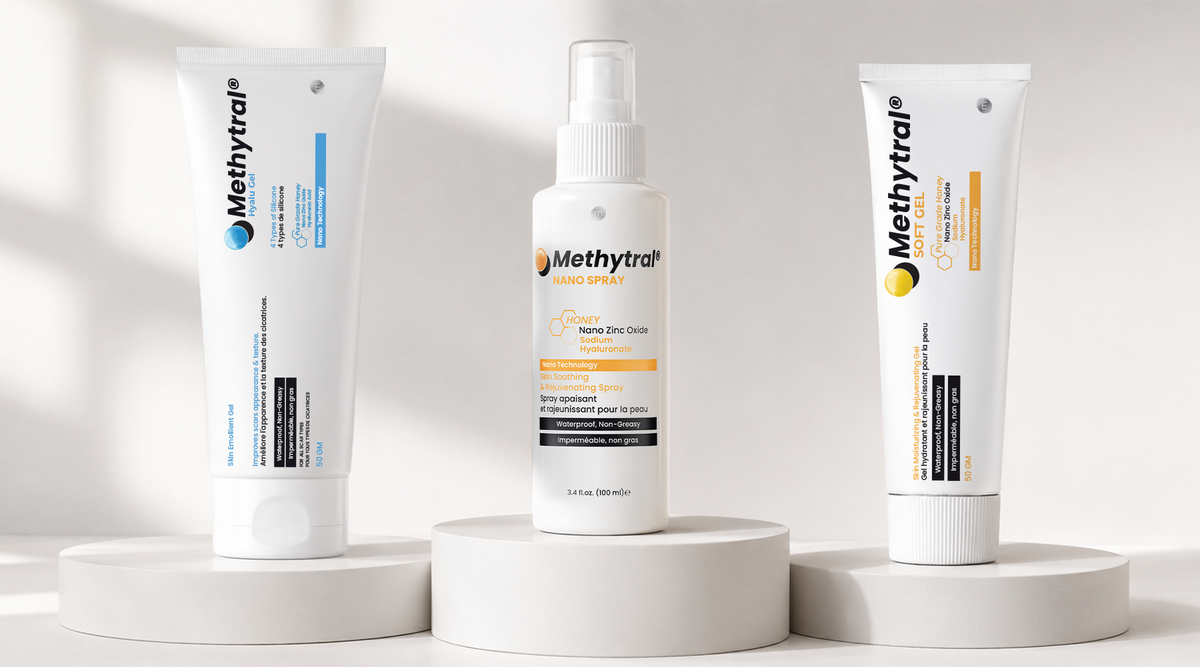
This is the stage for a product labelled for wound care, not a scar gel. Methytral Soft Gel is designed for direct application to selected minor wounds and burns where a gel layer and dressing are practical. Its published formula includes medical-grade honey, nano zinc oxide, sodium hyaluronate, beta-sitosterol and collagenase. Methytral Nano Spray lists the same core ingredients in a touch-free format for cuts, abrasions, cracks, grazes and other appropriate wounds.
Stage 3: monitor closure and infection signs
During normal healing, tenderness and redness should generally improve rather than spread. The wound edges move together and new tissue covers the surface. Some drainage can occur early, but increasing cloudy discharge, pus, bad odour, worsening pain, spreading redness, warmth, swelling, fever or wound reopening can indicate a problem.
These signs require prompt medical advice. A surgical wound should be managed according to the surgical team’s instructions, not changed to an over-the-counter routine without approval. Persistent or slow-healing wounds also need assessment, even if they are not very painful.
Stage 4: begin scar care only after full closure
Scar care begins when the wound has completely epithelialized: the surface is fully closed, dry and intact, with no open area, drainage or active scab. This timing varies with wound depth, location, health and treatment. If uncertain, ask the clinician who managed the wound.
Methytral Hyalu Gel is positioned for closed scars and combines silicone ingredients with honey, nano zinc oxide and hyaluronic acid. Silicone gel has the strongest general evidence among topical options for helping reduce the thickness and colour of some raised scars when used consistently on healed skin. Methytral Esthetic Cream is another closed-skin option combining triple silicones with onion extract, heparin, allantoin, collagen, arnica, peptides and supportive ingredients.
Never apply silicone scar products inside an open wound or over wet, draining tissue. Use a thin layer according to the label in one direction only and allow it to dry before clothing or sunscreen. Scar management takes time; visible changes are usually evaluated over months, not days.
Stage 5: protect the new scar from sunlight
New scars can darken with sun exposure. Once the skin is fully closed, protect the area with clothing and broad-spectrum sunscreen where appropriate. Continue gentle care and avoid picking, friction and unnecessary stretching. Raised, itchy, painful, contracting or expanding scars may benefit from dermatologist or plastic-surgeon assessment; options can include injections, lasers, pressure therapy or surgery depending on scar type.
The transition is simple but important: wound products support the open healing phase; scar products belong to the closed-skin phase. Methytral offers formats for both.
Editorial references
- MedlinePlus. “How wounds heal.” medlineplus.gov
- NHS. “Cuts and grazes.” nhs.uk
- World Health Organization. “Burns.” who.int
- American Academy of Dermatology. “Minimize a scar: Proper wound care tips.” aad.org
- American Academy of Dermatology. “Scars: Diagnosis and treatment.” aad.org
- Wang F et al. Efficacy of topical silicone gel in scar management: systematic review and meta-analysis. pubmed.ncbi.nlm.nih.gov
- Majestic Biopharma. Methytral official product pages. e-majestic.com/collections/methytral